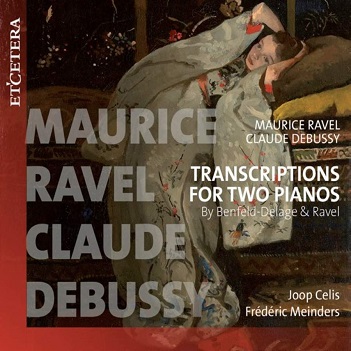
Transcriptions For 2 Pianos
Celis
Genre: Classical
CD | 1 disc(s) | Release: 06-03-2020
Verwachte levertijd (in NL): +/- 7 tot 15 werkdagen
Bestel- en levertijd
De getoonde levertijden (met uitzondering van In Stock-items) zijn enkel en alleen een gemiddelde op basis van de eerdere prestaties van achterliggende groothandels, distributeurs, labels en fabrieken.
Indien er geen voorraad is bij de Nederlandse distributeur/label/fabriek, dan kan het soms enkele weken duren! Dit betreft dan vaak een landelijke situatie.
BELANGRIJK: Om u een zo'n aantrekkelijk mogelijk verzendtarief/bezorgtarief te kunnen bieden, proberen wij orders van meerdere artikelen zoveel mogelijk gebundeld te versturen. Een deellevering is zeker mogelijk, maar over het algemeen is de algehele levertijd gelijk aan de levertijd van het artikel met de langste bestel- en levertijd! Neem dus gerust eerst contact met ons op indien u een deadline heeft. Wij kijken dan meteen of dit haalbaar is!*
ACTIE: 3% korting bij elke bestelling van min. 3 artikelen

Extra info
| Extra info: | Works By Ravel/Debussy |
|---|---|
| Maatschappij: | Outhere |
| Label: | Etcetera |
| Barcode: | 8711801016726 |
| Suffix - prefix: | 1672 KTC |
| Taal: | XX |
| Herkomst: | Holland |
| Instrument(en): | PIANO |
Beschrijving
Joop Celis & Frederic Meinders (pianos)
TRANSCRIPTIONS FOR TWO PIANOS BY BENFELD-DELAGE & RAVEL
Ravel and Debussy often made arrangements of their own compositions but we're not entirely sure why? A number of thoughts and arguments can be advanced to explain why an arranger (often the composer himself) should rewrite a piece for other instruments. Ferruccio Busoni tried to put into perspective the difference between the "original" and an "arrangement". He suggested that the original composition idea set down on paper is as "a portrait compared to the living model", and can therefore already be regarded as a sort of transcription. In the same way, the writing down of a musical idea can be seen as "an arrangement of the original", according to Busoni. Since the beginning of the nineteenth century, by far the best known and most used transcriptions are the piano arrangements of orchestral music and operas. In the days before radio and television and concert attendance was not always possible so another motive for transcription might be that the composer hopes that in this way his music will be played more often.
Debussy:
String Quartet in G minor, Op. 10
Ravel:
Introduction & Allegro for 2 pianos
String Quartet in F major
Aanbevolen

Handel: Music For Queen Caroline
Les Arts Florissants & William Christie
CD
Classical
€ 19,95
Details