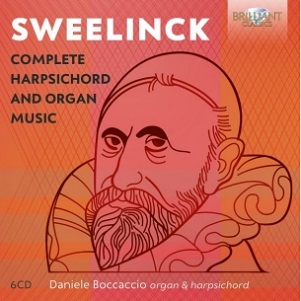
Sweelinck: Complete Harpsichord and Organ Music
Daniele Boccaccio
Genre: Classical
CD | 6 disc(s) | Release: 03-04-2020
Verwachte levertijd (in NL): +/- 7 tot 15 werkdagen
Bestel- en levertijd
De getoonde levertijden (met uitzondering van In Stock-items) zijn enkel en alleen een gemiddelde op basis van de eerdere prestaties van achterliggende groothandels, distributeurs, labels en fabrieken.
Indien er geen voorraad is bij de Nederlandse distributeur/label/fabriek, dan kan het soms enkele weken duren! Dit betreft dan vaak een landelijke situatie.
BELANGRIJK: Om u een zo'n aantrekkelijk mogelijk verzendtarief/bezorgtarief te kunnen bieden, proberen wij orders van meerdere artikelen zoveel mogelijk gebundeld te versturen. Een deellevering is zeker mogelijk, maar over het algemeen is de algehele levertijd gelijk aan de levertijd van het artikel met de langste bestel- en levertijd! Neem dus gerust eerst contact met ons op indien u een deadline heeft. Wij kijken dan meteen of dit haalbaar is!*
ACTIE: 3% korting bij elke bestelling van min. 3 artikelen

Extra info
| Extra info: | Daniele Boccaccio |
|---|---|
| Maatschappij: | Clear Spot International |
| Label: | Brilliant Classics |
| Barcode: | 5028421956435 |
| Suffix - prefix: | 95643 |
| Taal: | XX |
| Herkomst: | Holland |
| Solist(en): | DANIELE BOCCACCIO |
Beschrijving
Daniele Boccaccio (organ/harpsichord)
The only available complete set of Sweelinck’s keyboard music performed by a single artist: new and beautifully realised recordings.
‘A splendid recording by a fine artist’: Choir and Organ magazine on Daniele Boccaccio’s organ version of Bach’s Well-Tempered Clavier (95157) – the first ever such project. Now Boccaccio travels back several generations, to Jan Pieterszoon Sweelinck (1562-1621). This Italian-trained. Amsterdam-based organist/composer/teacher is the real father of the North German school, including not only the Bach family but also Scheidt and Buxtehude. All these composers were aware of and decisively influenced by Sweelinck.
Sweelinck's extant keyboard output comprises some seventy pieces. The precise instrument for which each of the pieces was written cannot always be determined with certainty. While the chorale settings most likely were intended for the organ and the secular song variations for harpsichord or virginal, Sweelinck's fantasias and toccatas (over thirty in number) may well have been played on whatever keyboard instrument was at hand.
Boccaccio has paid careful attention to the details of old fingering techniques; the resultant variety in phrasing and articulation gives new life to figurations that with a more modern legato approach can seem plain. As his own booklet note explains, he has also taken considered decisions about when discreet ornamentation can enhance the music's impact and when to let Sweelinck's notes speak for themselves. Particularly in the fantasias, he captures some of the freshness with which Sweelinck's music must have struck its first listeners.
He has chosen three different instruments for the organ performances: the Arp Schnitger organ (1678) in the Johanneskirche, Oederquart; a Fritz Scherer organ (1612/13) in the Marienkirche, Lemgo; and an instrument of unknown manufacture from around 1550 in the Andreaskirche, Ostönnen. The harpsichord is a modern copy of a 1679 model by the Flemish maker Jan Couchet. A project long in the making, this set will command the attention of all early- and Baroque-music lovers.
This 6-CD set present the complete keyboard music (organ and harpsichord) of Holland’s most famous composer: Jan Pieterszoon Sweelinck.
Jan Pieterszoon Sweelinck (1562-1621) was one of the most influential composers of the Late-Renaissance and Early-Baroque. He was organist of the Oude Kerk in Amsterdam for 44 years. His influence was enormous, he attracted composers from many European countries to Amsterdam to learn his art. Even the great Johann Sebastian Bach acknowledged his superior craftsmanship.
Sweelinck’s keyboard music is divided into 4 groups: Fantasias, Toccatas, Chorale variations (sacred works), Variations on Dances (secular works). Traditionally Dances were performed on the harpsichord, Chorale Variations on the organ. Fantasias, Toccatas, Fugues and Ricercari had only a non-specific “keyboard” destination.
Daniele Boccaccio is one of Italy’s foremost keyboard players. A scholar as well, he did extensive research into historic sources. He plays 3 different historic organs and a copy of a Flemish harpsichord.
Sweelinck:
Allein Gott in der Höh sei Ehr
Allein zu dir Herr Jesu Christ, SwWV309
Allemanda: Soll es sein
Almande Gratie, SwWV318/N7 'More Palatino'
Christe qui lux es et dies, SwWV301
Da pacem Domine in diebus nostris, SwWV302
Die flichtige Nimphæ, SwWV331
Echo Fantasia
Echo-Fantasia (dorisch)
Engelsche Fortuyn
Erbarm dich mein, o Herre Gott
Est-ce Mars, SwWV 321
Fantasia (auf die Manier eines Echo) C3, SwWV 255
Fantasia [contraria à 4], SwWV270
Fantasia à 2, 3 and 4 voices a2, SwWV 274
Fantasia a 3 in G minor, SwWV271
Fantasia à 4 a1, SwWV 273
Fantasia à 4 C2, SwWV 254
Fantasia a? 4 d2, SwWV259
Fantasia à 4 F2, SwWV 264
Fantasia à 4 G1, SwWV 266
Fantasia à 4 G2, SwWV 267
Fantasia auf die Manier eines Echo C1, SwWV 253
Fantasia C5, SwWV 257
Fantasia Chromatica 'Dorian'
Fantasia d5, SwWV 262
Fantasia Ut re mi fa sol la, à 4 F1, SwWV 263
Fantasia/Fuga 7. toni G3, SwWV 268
Fantazia g3, SwWV 272
Ich fuhr mich vber Rheine, SwWV322
Ich ruf zu dir, Herr Jesu Christ, SwWV305
Jesus Christus unser Heiland, SwWV 306
Mein junges Leben hat ein End
Nun freut euch lieben Christen gmein, SwWV307
O God, die onse Vader bist, SwWV308
Onder een linde groen, SwWV 325
Pavana hispanica
Pavana Lachrimae
Pavana Philippi, SwWV 329
Praeludium (or Fantasia), SwWV 265
Psalm 116 - Ik heb den Heer lief
Psalm 140, D41
Psalm 23, SwWV 310, 'Mein Huter und mein Hirt'
Psalm 36: Des boosdoenders wille seer quaedt in F Major, SwWV311
Psalm 60, SwWV 312
Puer nobis nascitur
Ricercar del nono tono a1, SwWV280
Toccata 2di Toni g2, SwWV 293
Toccata 5 toni C3, SwWV 284
Toccata 9. Toni a1, SwWV 296
Toccata a 3 G2 SwWV289/L23
Toccata à 4 a3, SwWV 298
Toccata C1, SwWV 282
Toccata C2 SwWV283/L20
Toccata d1, SwWV 285
Toccata G1, SwWV 288
Toccata G4, SwWV 291
Toccata Noni Toni SwWV297/L16
Toccata Primi Toni d2 SwWV286/L15
Toccata primi toni d3, SwWV 287
Toccata Secundi Toni g1 SwWV292/L21
Wir glauben all an einem Gott, SwWV316
"De beeltenis van Jan Pieterszoon Sweelinck sierde ooit het bankbiljet van vijfentwintig gulden en zijn klaviermuziek heeft altijd wel enigermate in de belangstelling gestaan. Aan het begin van zijn carrière nam Ton Koopman op vier lp’s de eerste omvangrijke Sweelinck-anthologie op. Op dit moment is er keuze uit maar liefst vier integrale opnamen van Sweelincks klavierwerken, met als nieuwste loot aan de stam die van Daniele Boccaccio. Sweelinck werd in Duitsland ‘der Organistenmacher’ genoemd, vanwege zijn enorme invloed op de Noord-Duitse orgelmuziek. Zijn leerlingen gaven zijn muziek door aan hun eigen leerlingen, tot Buxtehude aan toe, en dan ben je nog maar één handdruk verwijderd van Johann Sebastian Bach. Boccaccio bespeelt drie Duitse orgels en een Vlaams klavecimbel en hij koos ervoor om de instrumenten op iedere cd af te wisselen. Dat werkt goed, al vraagt het soms wat gedraai aan de volumeknop tijdens het afspelen. Boccaccio heeft grondige studie gemaakt van de oude vingerzettingen, iets dat lang niet al zijn collega’s doen. Het gebruik daarvan maakt het spelen over het algemeen niet makkelijker maar de muziek wel helderder en minder robuust. Boccaccio speelt vindingrijk en laat Sweelincks onbegrensde fantasie optimaal uitkomen."
Klassieke Zaken Magazine 3-2020
Aanbevolen
Recent bekeken