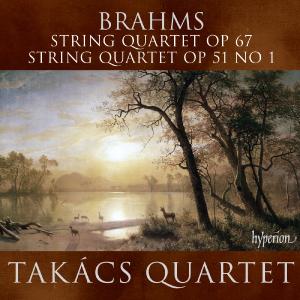
Brahms: String Quartets Nos. 1 & 3
Takacs Quartet
Genre: Classical
CD | 1 disc(s) | Release: 11-01-2008
Verwachte levertijd (in NL): +/- 7 tot 15 werkdagen
Bestel- en levertijd
De getoonde levertijden (met uitzondering van In Stock-items) zijn enkel en alleen een gemiddelde op basis van de eerdere prestaties van achterliggende groothandels, distributeurs, labels en fabrieken.
Indien er geen voorraad is bij de Nederlandse distributeur/label/fabriek, dan kan het soms enkele weken duren! Dit betreft dan vaak een landelijke situatie.
BELANGRIJK: Om u een zo'n aantrekkelijk mogelijk verzendtarief/bezorgtarief te kunnen bieden, proberen wij orders van meerdere artikelen zoveel mogelijk gebundeld te versturen. Een deellevering is zeker mogelijk, maar over het algemeen is de algehele levertijd gelijk aan de levertijd van het artikel met de langste bestel- en levertijd! Neem dus gerust eerst contact met ons op indien u een deadline heeft. Wij kijken dan meteen of dit haalbaar is!*
ACTIE: 3% korting bij elke bestelling van min. 3 artikelen

Extra info
| Maatschappij: | Universal |
|---|---|
| Label: | Hyperion |
| Barcode: | 0034571175522 |
| Suffix - prefix: | 117552 003457 |
| Taal: | EN |
| Herkomst: | Holland |
Beschrijving
Takács Quartet
New recordings by the Takács Quartet on Hyperion have become important landmarks in the musical calendar. This second disc of Brahms string quartets looks set to repeat all the commercial and critical success of their first.
It took twenty years for the famously self-critical Brahms to release his Op 51 string quartets for publication. Despite frequent requests, they were held back until they had reached his requisite standard of perfection. It is clear that Brahms’s struggle with the string quartet medium eventually led him to find an intensely personal language for it, with an unmistakable originality of melody and texture. Op 51 No 1 is both suffused with great musical richness and organically unified, with each idea growing with unerring logic out of the last in a process of continual development, and the main subject of each movement clearly arising out of the same germ.
Having hesitated so long over his first two string quartets, Brahms managed to produce their successor, Op 67, without any protracted birth-pangs, and the fact that the new work was dedicated to a well-known physician prompted him to elaborate on the medical analogy. ‘I am’, he told Theodor Wilhelm Engelmann (the husband of the pianist Emma Brandes, and himself a keen amateur cellist) ‘publishing a string quartet, and may need a doctor for it (as with the first ones). This quartet rather resembles your wife—very dainty, but brilliant! … It’s no longer a question of a forceps delivery; but of simply standing by. There’s no cello solo in it, but such a tender viola solo that you may want to change your instrument for its sake!’
Brahms:
String Quartet No. 1 in C minor, Op. 51 No. 1
String Quartet No. 3 in B flat major, Op. 67
"Their approach is alert, texturally clear and passionate … these are admriable performances which I recommend to any prospective buyer … this new Takács reading weighs in at the top end of the many available versions."
BC Music Magazine
"Viola to the fore in the third movement, Agitato, of No 3; and Geraldine Walther, firm-toned and assertive, rises to the occasion as the only un-muted instrumentalist here. Agitation isn't consistently maintained though because the Takács Quartet tend to ease the tension in places. Yet there is no slack in the other movements.
This close-knit group unanimously stretch or tighten the rhythm, achieving evenly matched dynamics such as the sotto voce sequences in the opening Vivace, the hushed dolce e grazioso in the recapitulation of the Andante and the stilled peace of the G flat sixth variation in the finale. Walther is well in the picture in this movement too whereas elsewhere she appears occasionally to lose focus.
Not so in No 1. Her place on the right of the ensemble is firmly assured here. The work is 'commonly held to be representative of Brahms's austerity and asceticism' (Edwin Evans), and these epithets are apposite for the Takács, spare of style and tone. The players' control over the first movement doesn't preclude a range of rubato that serves to sharpen the musical argument. Nor does it preclude a linear drive that knits the six themes of the last movement into a coherent whole, while they do not let up on the melancholy of the middle movements, the third particularly dark. The recording is tonally credible but is widely separated."
Gramophone Classical Music Guide - 2010
Aanbevolen
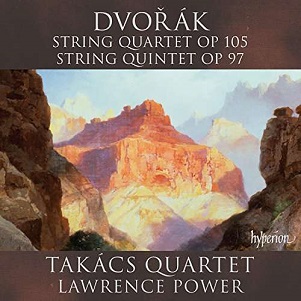
Dvorak: String Quartet Op. 106 & Coleridge-Taylor: Fantasiestucke
Takacs Quartet
CD
Classical
€ 20,95
Details